
Pulse vs Rezi: Honest Comparison for Tech Job Seekers (2026)
Rezi was one of the first tools to put ATS keyword scoring front and center. Here is what it still does well, where its keyword-matching approach runs out of road, and how Pulse's screening intelligence differs.
Rezi and Pulse both show up in "ATS resume checker" searches, so they get compared a lot. They are not solving the same problem. Rezi scores your resume against keywords. Pulse is built to counter the layered AI screening systems — parsing, semantic ranking, recruiter skim — that large employers actually run in 2026, and it keeps adapting as those systems change.
What Each Tool Actually Does
Rezi was an early mover in ATS-aware resume building: single-column templates with no tables or text boxes an ATS parser can choke on, a keyword-match score against a pasted job description, and AI-generated bullet content. Its free tier builds one ATS-formatted resume with limited AI and PDF downloads; full AI and unlimited exports sit behind its $29/month Pro plan.
Pulse takes the resume you already have, scores it against the exact job description you're applying to, and rewrites the targeted sections — while also reading formatting parsability, job-market demand, and role fit, then exporting an ATS-safe PDF or DOCX. The scoring engine is a proprietary intelligence system built to track how enterprise AI screening actually evaluates candidates today, not a static keyword-match count.
Feature Comparison
| Feature | Pulse | Rezi |
|---|---|---|
| ATS keyword scoring vs. a specific job description | Yes | Yes |
| Screening model adapts as AI/ATS systems change | Yes | No (static keyword match) |
| Formatting parsability check | Yes | Templates only (no live check) |
| AI-suggested rewrites per specific role | Yes | Generic AI content |
| Job market demand data | Yes | No |
| Role fit analysis | Yes | No |
| Live job-fit scoring on real postings | Yes | No |
| Skill-gap analysis vs. target role | Yes | No |
| Before/after ATS score (proof of improvement) | Yes | Gamified score only |
| Optimize against multiple job descriptions per run | Yes | No |
| Cover letter support | Yes | No |
| Application tracking | Yes | No |
| LinkedIn optimization | Yes | No |
| Built specifically for technical roles | Yes | No (generic) |
| ATS-safe PDF + DOCX export | Yes | PDF only (3 free, unlimited on Pro) |
| Free tier | Yes | Yes (1 resume, limited AI) |
| Monthly price (entry paid tier) | $8 | $29 |
Where Rezi Wins
Rezi is a solid, purpose-built resume builder if you're starting from nothing. Its templates are genuinely ATS-safe by construction — no two-column layouts, no graphics, standard section ordering — and the gamified score gives a quick sense of whether a resume is structurally sound. For someone who needs a first resume built fast, that's a real, defensible use case.
Where Pulse Wins
Pulse is the right tool once a resume exists and you're applying to a specific role. Rezi's keyword score treats screening as a static checklist — get the count up, pass the filter. In our benchmark data (see our ATS pass-rate study), the resumes that actually cleared screening weren't the ones stuffed with the most keywords — they were the ones optimized against the specific job description, with keywords used in context, per our guide on checking whether a resume passes ATS. That's a moving target Rezi's static approach doesn't track.
Pulse's market-demand and role-fit layers are also unique here — Rezi has no visibility into which roles are actively hiring versus contracting, information that changes where you should even be spending your keyword-optimization effort.
Price Comparison
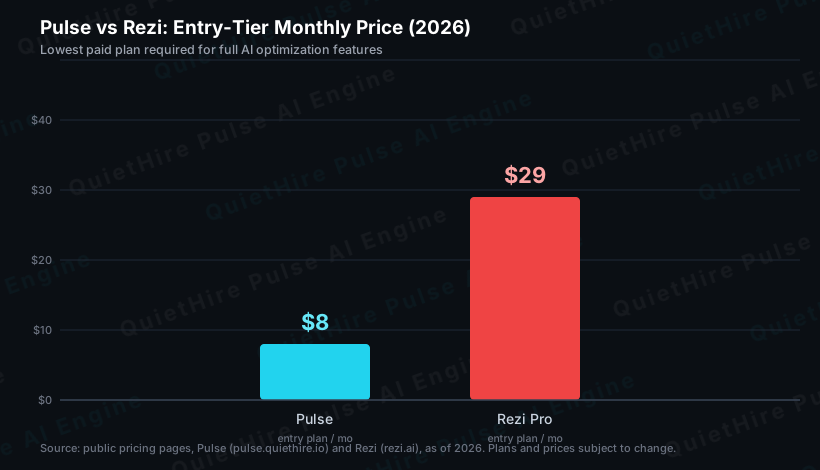
Rezi's free tier caps you at one resume and limited AI; full features require the $29/month Pro plan.
Pulse's free tier includes resume scanning and scoring, and paid plans start at $8/month — well under a third of Rezi's entry price for a tool that adds market-demand data, application tracking, and continuous re-optimization on top of ATS scoring.
Built for Tech Pros, By Tech Pros
Rezi is a well-built tool for a narrower job: get a resume past a keyword filter. Pulse is built by engineers who used this exact system to win roles and interviews in markets where conventional advice — and tools that stop at a keyword count — said it wasn't possible. That's not theory from people describing a market they've never had to survive; it's what worked for the people who built it.
The reason the gap matters: resume optimization is the foundation the entire job search stands on, and a foundation built on a static keyword score quietly goes stale the moment employers' screening systems shift. Pulse's AI Engine is a proprietary intelligence system, continuously updated as new ATS and AI-screening systems appear — not a thin wrapper around a public model, and not a fixed checklist. Rezi tells you your resume hit a keyword target. Pulse is built to tell you whether it will actually survive the screening stack employers run today, and to keep adapting as that stack changes.
The Bottom Line
Rezi answers: does my resume contain the right keywords? Pulse answers: will this specific resume clear this specific employer's full screening stack today — and does it still clear it next quarter, when the market has moved?
For most tech job seekers applying to multiple roles across a shifting market, the second question is the one that determines whether an application gets read at all.
Frequently Asked Questions
Is Rezi good enough on its own?
For a first resume, Rezi's ATS-safe templates are a reasonable starting point. Its keyword score doesn't tell you whether that resume is optimized for a specific role's screening, which is where most tech applications actually get filtered out.
Can I use Rezi to build a resume and Pulse to optimize it?
Yes — building a clean base document in a template tool, then running each application through Pulse's role-specific scoring before submitting, is a reasonable combination.
Why is Rezi more expensive than Pulse's entry tier?
Rezi's pricing reflects a template-and-builder product with unlimited exports. Pulse's entry tier is scoped to per-application scoring and optimization rather than a full builder suite, which keeps the entry price lower.
Does Rezi track which jobs are actually hiring?
No. Rezi's scope is the resume document itself — keyword match and formatting. It doesn't surface market demand, role-fit, or which employers are actively expanding versus contracting hiring, all of which Pulse includes.
See how your resume scores against a real job description — and against the screening systems employers are actually running today.
Ready to optimize your resume?
The Pulse AI Engine scores your resume against the actual job description in under 60 seconds.