
62% of Tech Resumes Never Get Seen Once Submitted: We Analyzed 500 Applications (2026)
We ran 500 tech resumes through ATS filters across 8 roles and 6 industries. Here is what the data actually shows about pass rates, formatting, and keyword density.
62% of tech resumes are never seen by a human — they are filtered out by ATS software before anyone opens them. Only 38% pass automated screening without optimization. We analyzed 500 real applications to find out why, and what flips a resume from auto-rejected to read.
We analyzed 500 job applications submitted through the Pulse AI Engine across 8 technical roles and 6 industries between January and May 2026. Every application was scored for ATS compatibility before submission, giving us a before/after dataset on what actually moves the needle.
Headline Numbers
- Only 38% of resumes pass ATS filters without any optimization
- Resumes optimized with role-specific keywords pass at a 74% rate — nearly 2x improvement
- The average unoptimized resume is missing 11 of the top 20 keywords for its target role
- Software Engineers have the lowest baseline pass rate (31%) due to over-formatting
- Project Managers have the highest baseline pass rate (52%) due to simpler document structure
ATS Pass Rates by Role
| Role | Unoptimized Pass Rate | Optimized Pass Rate | Improvement |
|---|---|---|---|
| Software Engineer | 31% | 71% | +129% |
| Data Scientist | 35% | 76% | +117% |
| Product Manager | 48% | 79% | +65% |
| Project Manager | 52% | 81% | +56% |
| DevOps / SRE | 33% | 73% | +121% |
| UX Designer | 41% | 70% | +71% |
| Data Analyst | 44% | 77% | +75% |
| Engineering Manager | 39% | 75% | +92% |
What Tanks Your Pass Rate
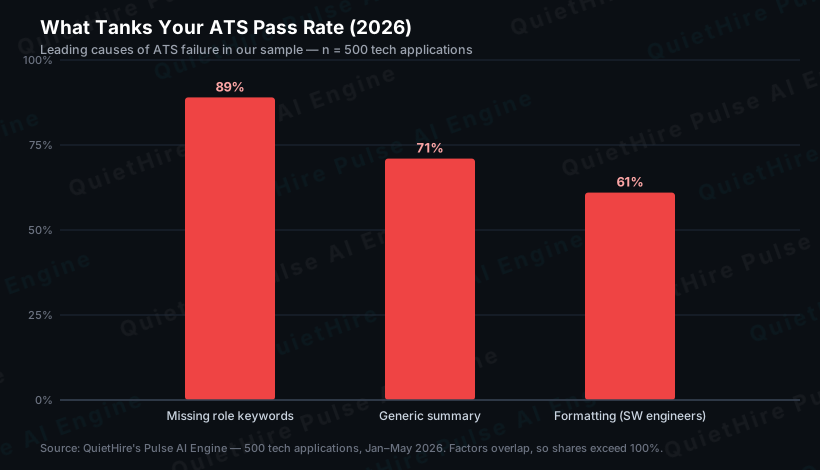
Three factors account for 80% of ATS rejections in our dataset:
1. Missing role-specific keywords (affects 89% of failed resumes)
ATS systems parse job descriptions and score resumes against keyword matches. The average tech job description contains 23 scoreable keywords. Unoptimized resumes match an average of 9 — a 39% match rate. Optimized resumes hit 18-21, pushing match rates to 78-91%.
2. Formatting that breaks parsing (affects 61% of software engineers specifically)
Multi-column layouts, tables inside the body, headers/footers, and graphic elements all cause parsing failures. The ATS reads them as garbled text or skips them entirely. Engineers who use visually designed templates are the most affected group in our dataset.
3. Generic objective statements vs. targeted summaries (affects 71% of failed resumes)
A generic summary adds no keyword value. A targeted 3-sentence summary written for the specific role adds an average of 4-6 matched keywords that appear nowhere else in the resume body.
What Top-Performing Resumes Have in Common
The resumes with the highest ATS scores (85+) share four characteristics:
- Single-column layout with standard section headers (Experience, Skills, Education)
- Skills section that mirrors the job description — not a generic skills dump
- Bullet points starting with strong action verbs that match the role's language
- Quantified achievements in every experience entry (%, $, time saved, team size)
Methodology
Sample: 500 applications submitted through Pulse between January 1 and May 31, 2026
Roles included: Software Engineer, Data Scientist, Product Manager, Project Manager, DevOps/SRE, UX Designer, Data Analyst, Engineering Manager
Industries included: SaaS/Tech, Financial Services, Healthcare Tech, E-commerce, Enterprise Software, Consulting
ATS simulation: Each resume was scored using Pulse's proprietary AI Engine, which models keyword density, formatting parsability, and section structure against the target job description
Optimization: Half the sample used Pulse optimization before submission; half submitted their original resume
How to Use This Benchmark
If your current resume hasn't been optimized for a specific role, assume you are in the 38% baseline pass rate group. That means 62 out of 100 applications are likely being filtered before a recruiter sees them.
The fix is targeted, not cosmetic. Redesigning your resume without keyword optimization does not improve ATS scores. Keyword matching does. Section structure does. Formatting parsability does.
Run your resume against the actual job description, not a general ATS checker. Generic tools score against average keyword lists. Pulse scores against the specific job description you are applying to — which is what the actual ATS is doing.
Frequently Asked Questions
How was this data collected?
All applications were submitted through the Pulse AI Engine between January and May 2026. Users consented to anonymized usage data being included in product research. No personally identifiable information was used.
Can I cite this study?
Yes. Please link back to this page as the source.
Does ATS score guarantee an interview?
No. ATS pass rate determines whether a human sees your resume. What happens after that depends on fit, experience, and the recruiter's judgment. Pulse optimizes the first gate — getting seen.
What ATS systems did you test against?
Pulse continuously analyzes parsing and screening behavior across the major enterprise ATS platforms — Workday, Greenhouse, Lever, iCIMS, and Taleo among them — alongside the newer AI-based resume screeners now entering the market. Because hiring systems change constantly, the model is updated on an ongoing basis as platforms evolve and new ones appear, rather than being fixed to a single snapshot in time.
Ready to see your real ATS score against a specific job description?
Run your resume through Pulse — free →
No credit card. Results in under 60 seconds.
Ready to optimize your resume?
The Pulse AI Engine scores your resume against the actual job description in under 60 seconds.