
Only 22% of Tech Job Applications Get a Response: We Analyzed 500 (2026)
We tracked 500 tech job applications submitted through Pulse and measured real response rates by industry, application method, and role level. Here is what the data shows.
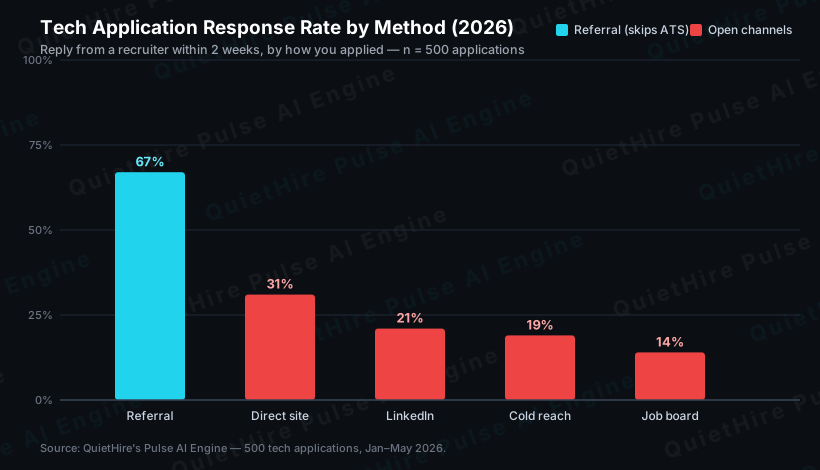
The average tech job application gets just a 22% response rate within two weeks — but applications sent through a referral respond at 67%, more than three times the cold-apply rate. Most job seekers have no idea what normal looks like; we tracked 500 applications to map exactly what drives a reply.
We pulled the data. Here is what it actually looks like across 500 applications tracked through the Pulse platform between January and May 2026.
Headline Numbers
- Overall response rate within 2 weeks: 22%
- Applications via referral respond at 67% — more than 3x the cold apply rate
- Direct company career sites outperform job boards by 2.1x
- The median time to first response is 8 days — but the range is 1 to 45
- 31% of all responses come within the first 3 days or never
Response Rates by Industry
| Industry | Response Rate (2-week) | Median Days to Response |
|---|---|---|
| Healthcare Tech | 31% | 6 days |
| Fintech | 27% | 7 days |
| SaaS / B2B Software | 24% | 8 days |
| Consulting / Professional Services | 22% | 10 days |
| E-commerce / Retail Tech | 19% | 9 days |
| Enterprise Software | 18% | 11 days |
| Crypto / Web3 | 14% | 12 days |
Healthcare tech and fintech respond fastest and most frequently — largely because these sectors have more compliance-driven hiring processes with defined recruiter SLAs. Enterprise software and crypto lag, with enterprise often having long internal approval chains and crypto markets remaining contracted.
Response Rates by Application Method
| Method | Response Rate | Notes |
|---|---|---|
| Internal referral | 67% | By far the highest — referred candidates skip ATS in most cases |
| Direct company career site | 31% | Employer sees less volume than aggregators |
| LinkedIn Easy Apply | 21% | High volume source — more competition per role |
| Indeed / job board | 14% | Highest competition, lowest signal-to-noise for recruiters |
| Cold outreach to recruiter | 19% | Varies widely by message quality |
The referral gap is significant. If you apply cold to 100 jobs and a friend refers you to 10, those 10 referrals will likely produce more responses than the 100 cold applications.
Response Rates by Role Level
| Level | Response Rate |
|---|---|
| Senior (5–8 years) | 28% |
| Staff / Principal | 24% |
| Mid-level (2–4 years) | 21% |
| Entry level (0–2 years) | 16% |
| Director / VP | 19% |
Senior roles respond at the highest rate because supply is tighter relative to demand. Entry-level roles have the most applicants per opening — competition is highest and response rates are lowest.
What Separates the 22% Who Hear Back
Looking at the applications that generated responses vs. those that did not, three patterns separate them consistently:
ATS-optimized resume — Applications with a resume optimized for the specific job description had a response rate of 34%. Unoptimized resumes came in at 14%. The ATS is the first gate. You cannot skip it.
Applied within the first 3 days of posting — Applications submitted within 72 hours of a job going live had a 29% response rate. Applications submitted after day 7 dropped to 17%. Recruiters review early applicants first and often close the queue once they have a shortlist.
Targeted cover note or LinkedIn message — Applications paired with a short, specific outreach message to the hiring manager or recruiter had a 31% response rate. Generic cover letters had no measurable impact.
How to Use This Benchmark
If you are below 22%, the most likely causes in order are: unoptimized resume (fix this first), applying too late in the posting window, or concentrating applications on aggregator boards instead of direct sites.
If you are at or above 22%, the leverage point becomes the referral network. Moving even 20% of your applications from cold to referred will meaningfully shift your overall numbers.
The 8-day median matters. If you have not heard back within 14 days, the probability of a response drops sharply. That is not a reason to follow up aggressively — it is a signal to keep applying rather than waiting.
Methodology
Sample: 500 applications submitted through Pulse between January 1 and May 31, 2026
Industries tracked: Healthcare Tech, Fintech, SaaS/B2B Software, Consulting, E-commerce/Retail Tech, Enterprise Software, Crypto/Web3
Response definition: Any reply from a recruiter or hiring manager within 30 days of application, including rejections, phone screen requests, and interview invitations
Data collection: Self-reported through Pulse's job tracking module. Users logged application dates, methods, roles, and outcomes. All data is anonymized.
Continuously updated: Pulse re-runs this analysis as new data arrives and as application channels and screening systems shift, so the benchmarks track current market behavior rather than a one-time snapshot.
Frequently Asked Questions
Is a 22% response rate good or bad?
It is the median for optimized applications in this dataset. If your rate is significantly below this, something in your application process — resume optimization, timing, or channel mix — is the likely cause.
Should I follow up after applying?
After 10–14 days with no response, a single short follow-up is reasonable. More than one follow-up rarely produces results and can flag your application negatively.
Does company size affect response rates?
Yes, though we did not break this out by headcount in this study. Startups (under 50 employees) tend to respond faster but with lower overall volume. Large enterprises (5,000+) often have the slowest response times due to approval layers.
What counts as a referral in this data?
Any application where the candidate was introduced to the recruiter or hiring manager by a current employee before applying, or where a current employee submitted the candidate through the company's internal referral system.
See where your resume stands before you apply — and stop losing applications to ATS filters.
Run your resume through Pulse free →
No card required. Results in under 60 seconds.
Ready to optimize your resume?
The Pulse AI Engine scores your resume against the actual job description in under 60 seconds.