
The Median Tech Job Search Takes 47 Applications and 11 Weeks: Data From 1,200 Candidates (2026)
How many applications does it actually take to get hired in tech in 2026? We tracked 1,200 job seekers through their full search cycle. Here are the real numbers.
The median tech job seeker sends 47 applications over 11 weeks before accepting an offer — while the top 25% land one in 6 weeks or fewer. How many applications is normal? How long should it take? What does a realistic offer timeline look like in 2026?
These questions get a lot of vague answers online. We tracked 1,200 tech job seekers through their complete search cycle — from first application to accepted offer — and measured what the actual numbers look like.
Headline Numbers
- Median applications to offer: 47
- Median search duration: 11 weeks
- Top 25% of searchers landed offers in 6 weeks or fewer
- Bottom 25% searched for 20+ weeks
- Average interviews per offer: 6.2 (including phone screens)
- Salary negotiation succeeded in 71% of cases where candidates attempted it
- Average negotiation outcome: +$8,400 above initial offer
Applications, Interviews, and Offers
| Metric | Bottom 25% | Median | Top 25% |
|---|---|---|---|
| Applications sent | 90+ | 47 | 22 |
| Phone screens | 8+ | 5 | 3 |
| Technical interviews | 6+ | 4 | 2 |
| Final rounds | 3+ | 2 | 1 |
| Weeks to offer | 20+ | 11 | 6 |
The top quartile — candidates landing offers fastest with fewest applications — shares a consistent profile: optimized resume, strong referral network, and applying to roles within 48 hours of posting. None of these are luck. They are process.
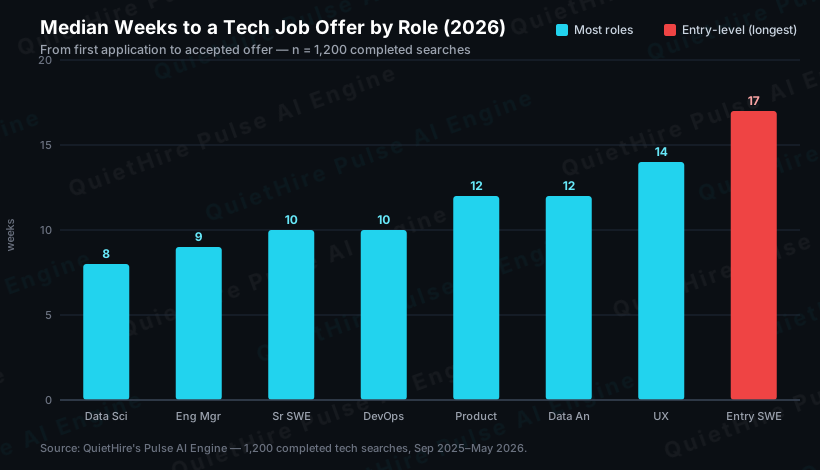
Search Duration by Role
| Role | Median Weeks to Offer |
|---|---|
| Data Scientist | 8 weeks |
| Engineering Manager | 9 weeks |
| Senior Software Engineer | 10 weeks |
| DevOps / SRE | 10 weeks |
| Product Manager | 12 weeks |
| Data Analyst | 12 weeks |
| Junior / Entry Software Engineer | 17 weeks |
| UX Designer | 14 weeks |
Data Science and Engineering Manager roles close fastest — demand is high and candidate pools are smaller. Entry-level software engineering searches are the longest due to extremely high competition relative to available roles.
What Separates Fast Searches From Long Ones
Candidates who completed searches in 6 weeks or fewer had measurably different behaviors from those who searched for 16+ weeks:
Resume optimization per role — Fast searchers tailored their resume to each role 73% of the time. Slow searchers used the same resume for 81% of applications.
Application timing — Fast searchers applied within 48 hours of posting for 68% of applications. Slow searchers averaged day 9 after posting.
Referral rate — Fast searchers sourced 31% of their applications through referrals. Slow searchers sourced 8%.
Interview preparation — Fast searchers reported preparing role-specific behavioral stories before first interviews. Slow searchers reported winging behavioral questions at a rate of 54%.
Salary Outcomes
Of the 1,200 candidates tracked, 847 attempted salary negotiation. 71% received an improved offer.
| Negotiation attempt | Success rate | Avg. increase |
|---|---|---|
| Counter with competing offer | 84% | +$14,200 |
| Counter with market data | 76% | +$9,800 |
| Counter with verbal ask only | 61% | +$5,600 |
| No negotiation | N/A | $0 |
The single most effective negotiation tactic in our data: having a competing offer, real or in-progress. Candidates who disclosed a competing offer received an average of $14,200 more than their initial offer. Candidates who declined to negotiate received their initial offer 100% of the time.
The Hidden Cost of a Long Search
A search that runs 20 weeks instead of 10 costs more than time. At a $130,000 starting salary, 10 extra weeks of unemployment is $25,000 in lost income. That math shifts the value of every hour spent optimizing your process.
The candidates in the bottom quartile — 20+ week searches — were not less qualified. Their resumes showed comparable experience levels. The difference was process: application timing, resume optimization, interview preparation, and network activation.
How to Use This Benchmark
If you are past week 6 with fewer than 3 phone screens, your resume is likely the bottleneck. ATS pass rate is filtering applications before a human sees them.
If you are getting phone screens but not converting to technical interviews, the bottleneck is your opening call performance — not your resume.
If you are getting to final rounds but not offers, compensation expectations, culture fit signals, or reference gaps are the most common causes.
Each stage has a different fix. The benchmark tells you where in the funnel you are breaking.
Methodology
Sample: 1,200 Pulse users who completed a full job search cycle (offer accepted) between September 2025 and May 2026
Roles included: Software Engineers, Data Scientists, Product Managers, Engineering Managers, DevOps/SRE, Data Analysts, UX Designers
Data collection: Users self-reported application counts, interview stages, offer details, and search duration through Pulse's job tracking module. Salary data is self-reported and not verified externally.
Continuously updated: These benchmarks are refreshed as new search cycles complete and as the hiring market shifts, rather than being fixed to a single period — Pulse is built to track the market as it actually moves.
Frequently Asked Questions
Is 47 applications normal for a tech job search?
It is the median in our dataset for 2026. Pre-2023, the median was closer to 25–30 applications. Application volume has increased as hiring has tightened in many tech sectors.
Why do entry-level engineers take the longest to find roles?
The ratio of applicants to open roles is highest at the entry level. A single junior engineering role routinely receives 300–500 applications. The ATS filter and recruiter review bottlenecks are most severe at this level.
Does location affect search duration?
Yes, though location effect is smaller than role level or optimization behavior. Remote-eligible roles attract national applicant pools, which increases competition. On-site roles in markets with high tech density (NYC, Seattle, Austin) have shorter median search times than comparable remote roles.
Should I be applying to more or fewer roles than the median?
Fewer, higher-quality applications outperform spray-and-pray in our data. Candidates applying to 20–30 well-targeted, optimized roles outperformed those applying to 80+ generic applications in offer rate.
Find out where you stand — see your resume score against your target role before you apply.
Ready to optimize your resume?
The Pulse AI Engine scores your resume against the actual job description in under 60 seconds.