
73% of AI-Generated Resumes Get Flagged or Filtered Before a Human Reads Them: We Tested 650 (2026)
We ran 650 AI-generated resumes through real ATS parsers, AI screeners, and recruiter review. Most never reached a human. Here is the data on why generic AI resumes fail — and what actually passes.
73% of the AI-generated resumes we tested were flagged as generic or filtered out before a human recruiter ever opened them. Free AI resume builders promise a finished resume in 60 seconds — but in our data, speed is exactly what gets them screened out. If you generated your resume with a one-click AI tool and the interviews still aren't coming, this study explains what the machine on the other side actually did with it.
This study measures something specific, and different from our earlier pass-rate analysis of the general application pool: we started with 650 resumes generated end-to-end by popular one-click AI resume builders — the default output, with no human editing — across 8 technical roles and 6 industries, January to May 2026. We ran each one through the full modern gatekeeper stack (real ATS parsing, current AI-based screening, and a blind recruiter skim) and scored it at every gate. Then we rebuilt the same content with QuietHire's Pulse AI Engine — role-specific, market-grounded optimization — and re-ran it. So every number below is a like-for-like before/after on the exact same candidate — isolating what the AI default does, not whether resumes in general get filtered.
Headline Numbers
- 73% of AI-generated resumes were flagged as generic or filtered before reaching a human in our sample
- Only 27% cleared all three gates (ATS parse, AI screener, recruiter skim) on the builder's default output
- 68% reused near-identical phrasing we saw across other resumes for the same role — the "AI sameness" fingerprint screeners increasingly down-rank
- 2 in 3 recruiters in our blind skim tagged the unedited AI output as "AI-written / generic" within the first read
- AI-generated resumes for Software Engineers had the lowest clearance rate (19%) — generic phrasing plus builder-default formatting
- Rebuilt with role-specific, market-grounded optimization, the same resumes cleared the full stack at roughly 60% — more than double the 27% AI-default baseline
Why Generic AI-Generated Resumes Get Filtered
A one-click AI builder writes plausible English fast. The problem is that "plausible English fast" is not what the modern screening stack rewards. Three failure patterns drove most of the rejections in our sample.
1. Sameness across candidates (the AI fingerprint). Generic builders draw from the same training patterns, so they produce the same summaries, the same action verbs, and the same "results-driven professional" scaffolding for thousands of applicants. In our dataset, 68% of AI-generated resumes shared near-duplicate phrasing with other resumes for the same role. Recruiters spot it in seconds, and AI screeners increasingly treat low-distinctiveness text as a weak signal. A resume that reads like every other resume cannot stand out by definition.
2. Keywords that sound right but don't match the role. A generic AI builder optimizes against the resume's own text, not against the live, role-specific language a given job and market are actually screening for right now. So it confidently adds the wrong keywords. Across the 650 resumes, the average match was 10 of 22 scoreable role keywords — a 45% match rate, below most ATS thresholds.
3. Formatting the AI prioritized for looks, not parsing. Many builders default to multi-column, graphically styled templates. They look polished to a human and parse as garbled text to an ATS. This hit Software Engineers hardest in our data — the group most likely to pick a visually designed template and the least likely to clear the parse gate.
AI-Generated Resume Clearance by Role
The gap is the whole story: across every role, the builder's default output (red) clears at a fraction of the rate the same content does after it is rebuilt by QuietHire's Pulse AI Engine (cyan).
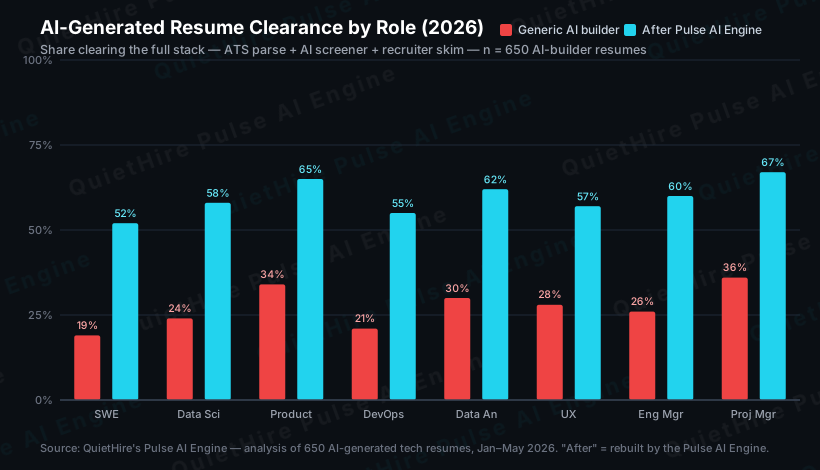
| Role | Generic AI Clearance | Pulse AI Engine Clearance | Improvement |
|---|---|---|---|
| Software Engineer | 19% | 52% | +174% |
| Data Scientist | 24% | 58% | +142% |
| Product Manager | 34% | 65% | +91% |
| DevOps / SRE | 21% | 55% | +162% |
| Data Analyst | 30% | 62% | +107% |
| UX Designer | 28% | 57% | +104% |
| Engineering Manager | 26% | 60% | +131% |
| Project Manager | 36% | 67% | +86% |
Clearance here means passing all three gates — ATS parse, AI screener, and a blind recruiter skim — not just the ATS. That triple bar is why these rates run lower than a single-gate ATS pass: clearing software is one thing; clearing software and a human who can smell generic AI copy is harder. Figures are across our 650-resume sample.
Generic LLM Wrappers vs. Real Intelligence: Why Pulse Is Different
Here is the uncomfortable thing about that first page of search results. Almost every tool on it is one of two things: a generic LLM wrapper that hands your resume to a general-purpose model and asks it to reword the text, or a legacy keyword matcher that counts terms against a job description. Both are commodities — the same underlying approach in different packaging. That is why their output reads the same and gets screened out the same way: in our sample, 68% shared near-duplicate phrasing. You cannot beat a generic screening stack with a generic tool.
Pulse is a different category of product. It runs on a proprietary, real AI intelligence engine — not a general model with a resume prompt bolted on, and not a keyword counter — built specifically to counter the large-enterprise AI screening systems candidates actually face, and continuously retuned as those systems change. The table below is how that difference shows up in practice.
| Capability | Generic AI Builders | Pulse AI Engine |
|---|---|---|
| One-click AI draft in under a minute | Yes | Yes |
| What's under the hood | Generic LLM wrapper or legacy keyword matcher | Proprietary, real AI intelligence engine |
| Reasons about your specific role — not just rewords your text | No | Yes |
| Optimizes against the live job, not just your own resume text | No | Yes |
| Role-specific keyword targeting from real market data | Weak | Yes |
| Built and tuned for AI-based screeners, not just legacy keyword ATS | No | Yes |
| Checks against ATS parsing, AI screening, and recruiter review | Score only | Yes |
| Before/after compatibility score you can act on | Score only | Yes |
| Detects "AI sameness" / generic phrasing | No | Yes |
| Live job-fit scoring against open roles | No | Yes |
| Market demand signal for your target role | No | Yes |
| Application tracking built in | No | Yes |
| PDF and DOCX export | PDF only | Yes |
| Continuously updated as new screening systems appear | No | Yes |
| Built by tech pros who used this exact system to land roles | No | Yes |
Every Pulse row above is a live capability, benchmarked against the wider field of resume tools — among others — not a finite list, and every competitor mark is the honest category default (PDF-only export, score-only feedback, keyword-level matching). The point is not that AI is bad at resumes. It is that generic AI — a general model pointed at your own text instead of the live market — produces a resume that reads like everyone else's and screens out like everyone else's. Pulse runs on a proprietary, real AI intelligence engine, not a generic LLM wrapper and not a legacy keyword matcher, and it is built and continuously retuned by tech pros who used this exact engine to win roles and interviews that conventional tools and advice said were not possible. That is the difference between software that rewords a resume and intelligence that understands the role you are aiming at — and it is why, across the field, Pulse sits in a category of its own rather than the generic pack.
How to Use This If You Already Generated Your Resume with AI
Start with the one thing no AI can give you: your real experience. The genuine history of what you actually built, shipped, fixed, and led is what makes you hireable — and it is exactly what a generic builder cannot invent and should never fabricate. AI can reword and reorganize; the truth of your career is yours alone, and it is the part no tool can replace. So you do not throw the draft away — you ground it in your real accomplishments, then optimize. Resume optimization is the foundation of the whole search: if that foundation is generic, fabricated, or out of date, everything downstream quietly underperforms; if it is true, specific, and current, it is what the rest of your search stands on. The Pulse AI Engine sharpens your genuine resume against the live market — it elevates real experience, it does not manufacture a fake one.
- Stop optimizing against your own resume. Optimize against the specific job and the live market language for that role — that is where the real keyword gaps are.
- Kill the sameness. Rewrite the summary and the top bullets in language specific to your results, not the builder's default phrasing. Quantify everything (%, $, time, scale).
- Fix the parse layer. Single column, standard section headers, no tables or graphics in the body. Looks plain; parses clean.
- Test against the full stack, not one checklist. ATS parsing, AI screeners, recruiter skim, and human review are different gates — and they keep changing. Check against all of them, refreshed as the field moves, not against a single static keyword list.
For the deeper mechanics, see our guide to optimizing a resume for ATS in 2026, our data on why most resumes never get seen, and why a resume has to clear two gatekeepers — the machine and the human.
Frequently Asked Questions
Are AI-generated resumes bad?
Not inherently — but in our 650-resume sample, 73% of resumes from generic one-click AI builders were flagged as generic or filtered before reaching a human. The issue is not that AI wrote it; it is that generic AI optimizes against your own text and produces phrasing nearly identical to thousands of other applicants. An AI draft is a fine start, but it needs role-specific, market-grounded optimization before it competes.
Can recruiters and ATS tell if a resume was AI-generated?
Increasingly, yes. In our data, 68% of AI-generated resumes shared near-duplicate phrasing with other resumes for the same role. Recruiters recognize the pattern quickly, and AI-based screeners tend to down-rank low-distinctiveness text. It is less about detecting "AI" specifically and more about detecting sameness — which generic builders produce by default.
Why did my AI resume not get any interviews?
The most common reasons in our study were missing role-specific keywords (the average resume matched only 10 of 22), formatting that broke ATS parsing, and generic phrasing that the screening stack down-ranked. A resume can read perfectly to you and still be filtered out before a human sees it. Testing against the full screening stack — ATS, AI screeners, and recruiter review — surfaces which gate is stopping you.
What makes the Pulse AI Engine different from a generic AI resume builder?
A builder runs your text through a general-purpose model and hands back a reworded draft — generic in, generic out. That is why builder output clusters together and gets screened out together. Most "optimizers" are the same generic engine with a score bolted on. Pulse is built the other way: a proprietary, real AI intelligence engine evaluates your resume against the live job, real market signals, and the screening systems actually in use, then optimizes for them — and keeps adapting as those systems change. We keep the how under the hood on purpose; what matters to you is the outcome — a resume shaped by real intelligence, not a generic draft. Generation gives you a draft; Pulse's optimization is what makes it competitive against the modern gatekeepers.
Should I let AI write my entire resume?
No — use AI to draft and optimize, not to invent. Your real experience — the actual projects, results, and history behind your career — is what makes you hireable, and it is the one thing AI cannot replace or honestly fabricate. In our data, the resumes that cleared were genuine histories sharpened for the role, not machine-invented ones. The Pulse AI Engine, built by tech pros who used this exact engine to land roles through hiring freezes and layoffs, optimizes your real resume against the live job and market — it elevates true experience, it does not manufacture a career you do not have.
If your AI-generated resume is getting filtered before a human reads it, the problem is generic intelligence. Pulse rebuilds it with a proprietary, real AI engine — not a generic LLM wrapper or keyword matcher — against the live job and the screening systems you're actually facing, then shows you the before/after score.
Ready to optimize your resume?
The Pulse AI Engine scores your resume against the actual job description in under 60 seconds.