
How to Evaluate Equity Compensation in a Tech Offer: RSUs & Options (2026)
A $150K equity grant can mean very different things depending on the company stage, vesting schedule, and instrument type. Here is how to actually evaluate what an equity offer is worth before you accept it.
A recruiter says "and there's a $200K equity grant" and most candidates nod like that settles it. It doesn't. The same headline number can be worth close to its face value at a public company, or close to zero at a startup that never has a liquidity event — and the difference is almost entirely in the details most offer letters don't spell out.
Key Takeaway
- RSUs and stock options are not the same instrument — RSUs have value the moment they vest; options only have value if the stock price is above your strike price.
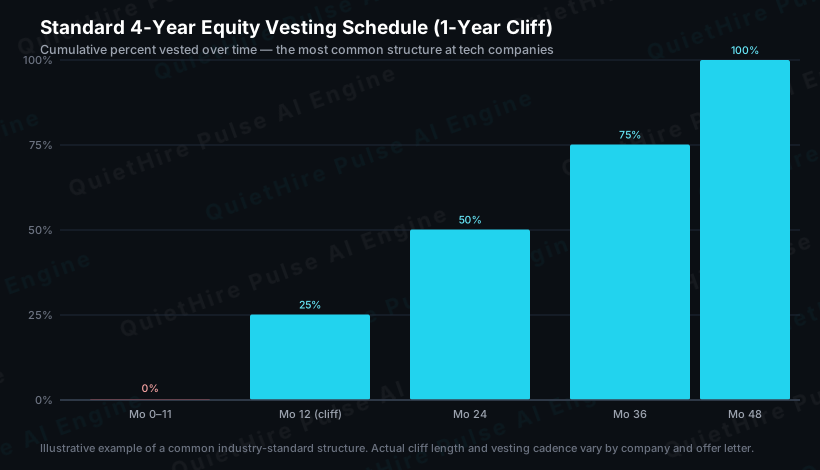
- Vesting schedule and cliff structure change the real timeline — a standard structure is a 1-year cliff followed by monthly or quarterly vesting over 4 years total.
- Pre-IPO equity carries real liquidity risk — you often can't sell it even if it's technically vested, until a liquidity event happens.
- The headline grant number is a share count times a valuation, and that valuation is uncertain at any private company.
- Evaluating equity is part of the same foundation as evaluating base salary — covered in our salary negotiation playbook — not a separate, optional step.
RSUs vs. Stock Options: The Core Difference
Restricted Stock Units (RSUs) are a promise of actual shares, delivered as they vest. At a public company, a vested RSU is effectively cash — you can sell it. At a private company, it's vested but usually illiquid until an IPO or acquisition.
Stock options are the right to buy shares at a fixed price (the strike price), usually set at the company's current valuation when the option is granted. Their value is the gap between the stock's price when you exercise and your strike price. If the company's valuation never rises above your strike price, the options are worth nothing — this is why options carry more risk than RSUs, and why later-stage or public companies increasingly grant RSUs instead.
Know which one you're being offered before you compare it to anything else. An offer letter that says "equity" without specifying the instrument type is a question worth asking directly.
Vesting Schedules and the Cliff
Most tech companies vest equity over 4 years, commonly with a 1-year cliff (nothing vests until your first anniversary, then a chunk vests at once) followed by monthly or quarterly vesting for the remaining 3 years. A $400K four-year grant under this structure doesn't mean $100K a year evenly — it typically means nothing for 12 months, then a lump-sum cliff vest, then smaller regular installments.
This matters directly when comparing offers: a grant that looks larger on paper but has a longer cliff or a back-loaded schedule can be worth less to you in year one than a smaller grant that starts vesting sooner.
Why the Headline Number Is Uncertain
The dollar figure recruiters quote is a share count multiplied by a valuation — and at a private company, that valuation (often set by the most recent funding round or a 409A appraisal) is an estimate, not a market price. It can be marked up in the next funding round, or down, or the company may never reach a liquidity event at all.
A reasonable way to stress-test a private-company grant: discount the headline number for the risk that the valuation doesn't hold and that you can't sell for years even if it does. Treating a public company's RSU grant and a pre-IPO startup's option grant as directly comparable dollar-for-dollar understates the real difference in risk between them.
How to Use This
- Confirm the instrument — RSU or option — and the strike price if it's options.
- Get the exact vesting schedule in writing, including cliff length, not just the headline total and duration.
- Ask what valuation the equity is based on and how recently it was set (a stale 409A from 18 months ago is a weaker signal than one set at last quarter's funding round).
- Weigh liquidity separately from value — vested-but-illiquid equity at a private company is not the same as cash-equivalent RSUs at a public one, even at the same headline dollar figure.
- Negotiate equity as part of the full package, not as an afterthought after base salary is settled — our tech salary negotiation guide covers negotiating base, equity, and bonus together.
Frequently Asked Questions
Are RSUs always better than stock options?
Not always, but RSUs carry less downside risk since they have value as soon as they vest, regardless of stock price movement. Options can outperform RSUs if the company's valuation rises significantly after the grant, but they can also end up worthless if it doesn't.
What is a 409A valuation and why does it matter?
A 409A valuation is an independent appraisal of a private company's common stock, used to set the strike price for new stock option grants. A more recent 409A, especially one tied to a recent funding round, is a more reliable signal of what your options are actually priced against.
How much should I discount a startup equity grant compared to a public company's RSUs?
There's no universal number — it depends on company stage, funding history, and your own risk tolerance. The point isn't to apply a fixed formula but to treat a private-company headline grant as meaningfully less certain than the same dollar figure in public-company RSUs, and factor that into how you compare competing offers.
Does a bigger equity grant always mean a better offer?
Not on its own. A larger grant with a longer cliff, an earlier-stage company, or an inflated internal valuation can be worth less in practice than a smaller grant with faster vesting at a company with clearer liquidity prospects.
Pulse's negotiation guidance weighs the full offer — base, equity, and bonus — against real market and company signal, not just the headline number.
Ready to optimize your resume?
The Pulse AI Engine scores your resume against the actual job description in under 60 seconds.