
Why You Keep Getting Ghosted After Applying to Jobs (and How to Fix It) — 2026
Most tech applications never get a reply. Here is why you keep getting ghosted after applying — and the part of it you can actually control.
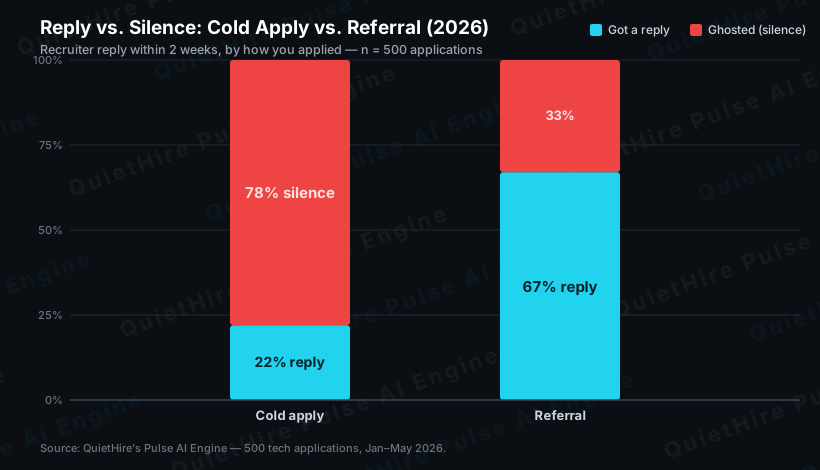
In our data, 78% of cold tech applications got total silence within two weeks — no rejection, no reply, nothing at all. If you have sent dozens of applications into the void and heard back from almost none of them, you are not imagining it, and you are not unqualified in the way the silence makes you feel. Getting ghosted after applying is now the default outcome of a broken top-of-funnel. Once you see exactly why it happens, you can stop feeding the void and start getting seen.
Key takeaway
- Most applications are filtered out before a human ever reads them — in our 500-application study, only 38% of unoptimized resumes cleared automated screening, and roughly 62% were never seen by a person.
- Ghosting is mostly a top-of-funnel problem, not a verdict on whether you can do the job.
- The single lever you fully control is your resume foundation — and getting it right roughly doubled pass rates in our data (38% → 74%).
- Open channels (job boards, one-click apply) get the least response; referrals and direct outreach flip the odds dramatically.
Why you keep getting ghosted after applying
The uncomfortable truth is that most applications are not rejected by a person — they are quietly discarded by a system, and a non-answer is the cheapest thing a company can give you. A few forces stack on top of each other:
You are filtered before a human ever looks. Modern hiring runs your resume through a screening stack — applicant tracking system parsing, AI-based screeners, and a fast recruiter skim — before anyone evaluates you as a candidate. In our 500-application analysis, 62% of unoptimized resumes never reached a human at all. Silence is what that filtering feels like from your side of the screen.
Application volume has exploded. One-click apply and AI application tools have flooded employers with more applications than they can possibly answer. When a posting collects hundreds or thousands of submissions, the company simply does not reply to most of them — there is no one to do it.
Some of the jobs are not real. A meaningful share of postings are "ghost jobs" — listings kept open with no current intent to hire, used to build a pipeline, gauge the market, or satisfy policy. You cannot win a role that was never going to be filled, and you will never be told that is why.
You are arriving through the weakest channel. A resume dropped into a job board or one-click apply lands in the largest, least-prioritized pile. In our data, applications through open channels replied at a fraction of the rate of referred ones — which is the single biggest reason cold applying feels like shouting into the dark.
None of these are about your talent. They are about a funnel that is structurally biased toward silence — which is also why blaming yourself is both inaccurate and unproductive.
The part of ghosting you actually control
You cannot fix ghost jobs, hiring freezes, or an overwhelmed recruiter. Spending energy there is wasted. What you can control is whether your application survives the screening stack long enough to be evaluated by a human — and that is where the leverage is.
In our 500-application ATS study, the difference between an unoptimized resume and one aligned to the specific role was not marginal: pass rates moved from 38% to 74% — nearly double the chance of being seen — without changing a single fact about the candidate's experience. The content was the same; the alignment to what the role and its screening systems were actually looking for was not.
This is why a resume that is "good" in the abstract still gets ghosted. The screening systems are not grading writing quality. They are checking, role by role, for the specific signals that posting is built to find — and those signals change constantly as new screening tools come online. A resume frozen on last year's advice quietly fails against this year's filters, and you never get told why.
That is the foundation Pulse is built to fix. Pulse was created by engineers who personally job-hunted through layoffs and downturns — not theorists describing a market they never had to survive — and it uses a proprietary AI engine that is continuously updated against the ATS and AI-screening systems candidates actually face, rather than a static, decade-old keyword checklist. The point is not a prettier document. The point is getting your real experience past the filters that are ghosting you now.
How to stop getting ghosted
You stop getting ghosted by fixing the things inside your control and abandoning the things that are not. In order of leverage:
1. Get your resume foundation right — and keep it current. This is the highest-leverage move because every application rides on it. Bring your existing resume (not a generic one built from a blank page) and align it to each target role against real, current screening signals. See our guide to optimizing your resume for ATS for the mechanics, and run it through a tool that scores you against the actual job before you submit.
2. Stop relying on the weakest channel. If most of your applications are one-click submissions to job boards, you are choosing the pile with the lowest reply rate. Shift effort toward referrals and direct outreach to the people who actually own the role — our guide on reaching the hiring manager directly walks through how to get in front of a human instead of a queue.
3. Target fewer roles, better. Spraying applications across every opening lowers your fit on each one and guarantees more silence. Concentrate on a short list of roles you genuinely match, and put your optimized resume and a real outreach effort behind each.
4. Set a follow-up rule and then let go. Know what normal looks like so silence does not wreck you — most replies that come arrive within the first days, not weeks (see how long it really takes to hear back). Send one follow-up after about a week. If a second week passes with nothing, treat it as a dead lead and move your energy to live opportunities. Closure you give yourself beats closure you wait for.
The shift that ends the ghosting spiral is moving from volume into the void to fit through the right channel, on a foundation that actually passes. That is fewer applications, more replies — which is the entire point.
Frequently Asked Questions
Why am I getting ghosted after applying even though I am qualified? Because most applications are filtered by screening systems before a qualified human ever evaluates them. In our 500-application study, 62% of unoptimized resumes never reached a person — so "qualified" never gets a chance to matter. The fix is making sure your resume clears the automated stack for that specific role, then arriving through a channel a human actually monitors.
Is getting ghosted my fault? Mostly not. Ghost jobs, hiring freezes, overwhelmed recruiters, and flooded application piles are structural and outside your control. What is in your control is whether your resume survives screening and which channel you use — and those two levers are where nearly all of your improvable odds live.
How long should I wait before assuming I have been ghosted? Most replies that come arrive within the first several days. A reasonable rule is to send one follow-up after about a week, and if another week passes with no response, treat the role as a dead lead and redirect your effort. Waiting longer rarely changes the outcome and drains energy you need for live opportunities.
Does optimizing my resume actually reduce ghosting? In our data it does, substantially. Aligning a resume to the specific role moved pass rates from 38% to 74% across our sample — nearly doubling the chance of reaching a human. It does not guarantee a reply, but it removes the most common reason applications go silent: being filtered out before evaluation.
Should I keep cold-applying through job boards? You can, but expect the lowest reply rate there. In our data, open channels responded at a fraction of the rate of referrals. Treat job boards as a supplement, and put your real effort into an optimized resume plus direct outreach to the people who own the roles you want.
Pulse fixes the part of ghosting you actually control — it scores your real resume against each specific role and shows you exactly what is getting you filtered, so your application reaches a human instead of the void.
Ready to optimize your resume?
The Pulse AI Engine scores your resume against the actual job description in under 60 seconds.