
What Is AI Resume Screening? How It's Different From the ATS in 2026
The ATS didn't disappear — a newer AI layer got stacked on top of it. Here is what AI resume screening actually evaluates, how it differs from keyword-matching, and what that means for how you write a resume in 2026.
Most candidates still describe getting filtered out as "the ATS ate my resume." In 2026, that's only half the story. The classic parser still runs first, but at most large employers an AI layer now sits on top of it — reading meaning, not just keyword counts, before a human ever opens the file.
Key Takeaway
- The ATS parses your resume and extracts structured fields (title, dates, skills); it's largely unchanged in mechanics from a decade ago.
- The newer AI screening layer semantically ranks candidates who survive the parse — it rewards a keyword used in relevant context over one stuffed in a list.
- These two systems run in sequence, not as replacements for each other — you have to clear both.
- The AI layer keeps changing as employers adopt new tools, which is why a resume optimized once quietly goes stale.
- In our ATS pass-rate study, resumes optimized against the specific job description passed at nearly double the rate of generic ones — the gap this guide explains.
What the ATS Still Does
An Applicant Tracking System's job hasn't fundamentally changed: it parses your resume into structured data — job titles, dates, skills, education — and checks that structure against filters the recruiter set up (required keywords, years of experience, location). If your resume's formatting breaks the parser — tables, text boxes, headers/footers holding key content — the ATS may never extract that information correctly in the first place, regardless of what an AI layer does afterward.
That's the foundation layer, and it's still worth getting right. Our guide to optimizing a resume for ATS covers the formatting side in detail.
What the AI Screening Layer Adds
Where things changed is what happens to the resumes that survive the ATS parse. Instead of a recruiter scrolling a results list, an AI layer increasingly does a first pass: semantic matching (recognizing that "led a team of engineers" and "managed an engineering team" mean the same thing), composite fit-scoring against the full job description rather than a keyword checklist, and routing — flagging high-confidence matches for review and pushing low-confidence ones down the queue or out entirely.
The practical difference: keyword stuffing stopped working as well as it used to, and context started mattering more. A resume that lists "Python" in a skills block with no supporting evidence ranks lower than one where Python appears inside a specific, verifiable accomplishment tied to the role being screened.
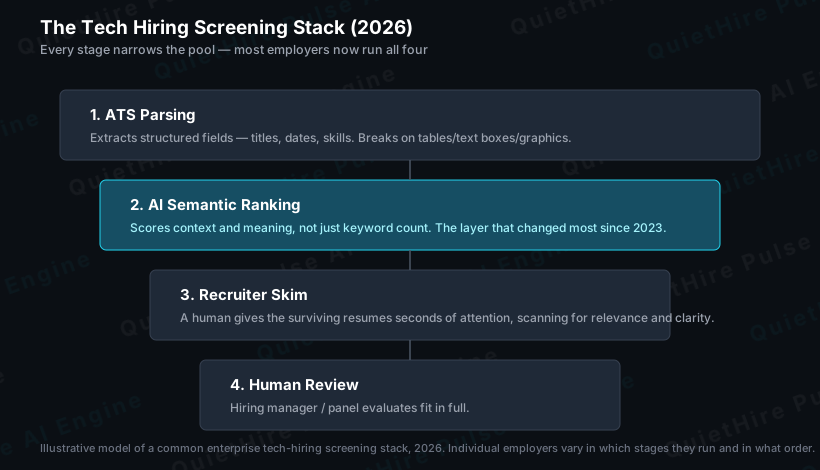
This is also why the screening stack candidates face isn't one static system — it's the ATS parser, an AI ranking layer, a recruiter skim, and human review, and each employer runs a different mix. Treating any one of those as "the" filter to beat is how a resume that passed one company's screening gets filtered by the next.
Why This Is a Moving Target, Not a Fixed Checklist
Enterprise AI screening isn't standardized the way ATS parsing largely is — employers are continuously adopting, swapping, and retraining these systems. A resume tuned for what one employer's AI layer rewarded last quarter isn't guaranteed to read the same way against a different employer, or the same employer's updated model, next quarter. Static advice ("just use these 20 keywords") ages out quickly for exactly this reason.
Where AI-Written Resumes Run Into This
Generic AI resume generators produce exactly the kind of content the AI screening layer is now tuned to discount: broad, template-shaped phrasing that isn't tied to a specific accomplishment or a specific role. Our study on 650 AI-generated resumes found most never reached a human — not because they were obviously AI-written, but because generic phrasing doesn't hold up against context-aware ranking the way a specific, role-targeted rewrite does. The lesson generalizes beyond AI-written resumes specifically: any resume built once and reused unchanged across many applications runs into the same problem, because context-matching is inherently per-role.
How to Use This
- Get the formatting right first — a resume the ATS can't parse correctly never reaches the AI layer at all.
- Write for context, not count — use each keyword inside a specific, real accomplishment tied to the target role, not as a standalone list.
- Re-score per application, not once — because the AI layer weighs context and semantics differently than a keyword count, the same resume can perform differently against two different job descriptions.
- Re-check periodically, not just per application — as employers' screening systems evolve, a resume that cleared screening six months ago isn't guaranteed to clear it today. Our guide on checking whether your resume will pass walks through verifying this before you submit.
Frequently Asked Questions
Is AI resume screening the same thing as an ATS?
No. The ATS is the underlying system that parses and stores your resume data. AI resume screening is a newer layer, increasingly stacked on top of the ATS at large employers, that semantically ranks the candidates who survive the initial parse.
Does AI resume screening mean keywords don't matter anymore?
Keywords still matter — they're how both the ATS and the AI layer identify relevant skills. What changed is that context matters alongside frequency: a keyword used inside a specific, relevant accomplishment ranks higher than the same keyword repeated in a list with no supporting detail.
Can I tell if a specific employer uses AI screening?
Rarely directly — employers don't typically disclose their screening stack. The safer assumption for any mid-size or large tech employer in 2026 is that some AI-assisted ranking sits between the ATS parse and a human recruiter's first look.
How often should I re-check my resume against AI screening?
Per application at minimum, since context-matching depends on the specific job description — and periodically beyond that, since the screening systems themselves keep changing as employers adopt new tools.
Pulse's screening intelligence is built to track how AI resume screening actually evaluates candidates today — continuously updated as employers' systems change, not a fixed keyword list.
Ready to optimize your resume?
The Pulse AI Engine scores your resume against the actual job description in under 60 seconds.